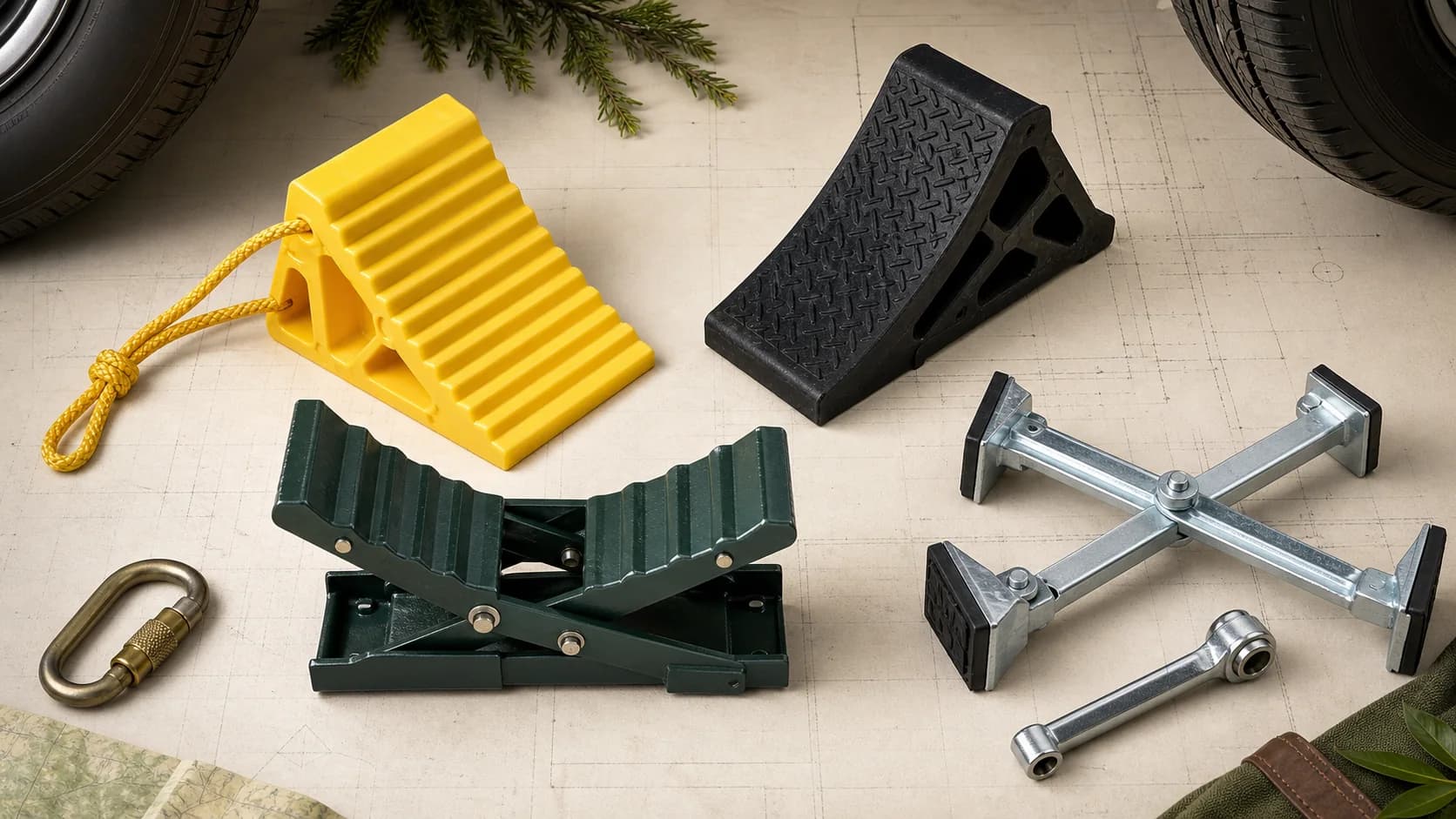
A chock helps resist unintended movement only when it matches the tire and surface, is placed correctly, and is used with the tow vehicle or trailer parking procedure—not as a substitute for it.
Original TowCheck editorial artwork. Generic equipment is shown; product-format diagrams below are not scale replicas.
01 · Start here
Three distinct fits, not a universal winner
Choose the operating pattern that resembles your setup, then verify every capacity and compatibility constraint.
01
moulded wedge
Best for A lightweight conventional chock for a documented tire-size class
Camco 44414 Wheel Chock
The simple portable option when the tire is within Camco’s stated 26-inch-diameter boundary and the surface and slope allow a conventional moulded chock to seat fully.
Format
Single-wheel wedge
Documented fit
Tires up to 26 in diameter
Important limit: The reviewed manufacturer record does not publish a vehicle-weight or grade rating. Lightweight moulded construction may be less planted on slick, uneven, or soft surfaces.
Best for A compact, dense rubber wedge for routine trailer positioning
Buyers Products WC1467A
The conventional rubber option when its 8 × 5 × 4-inch body seats well against the actual tire and the absence of a published load/grade rating is acceptable for the planned use.
Format
Single-wheel wedge
Documented fit
8 × 5 × 4 in; verify tire contact
Important limit: The reviewed product page does not state a maximum vehicle weight, tire diameter, or slope rating, so those must not be assumed from its dense appearance.
Best for Chocking both sides of a tandem-axle tire pair in one placement
Fastway ONESTEP 84-00-4000
The tandem-specific parking option when the measured outside tire spacing is 16–24 inches and the site is level or only gently sloped as the instructions require.
Format
Outside tandem spanning chock
Documented fit
16–24 in outside tire spacing
Important limit: It is only for tandem geometry within range, and the manual says not to use it on excessive grades. It must be removed and accounted for before towing.
Best for Reducing tandem-tire movement after primary parking chocks are set
BAL X-Chock 28012
The between-tire stabilizer here—not the primary parking chock—when tandem spacing falls within 1 3/8–10 inches and stabilizing tire shift is the goal.
Format
Between-tire scissor stabilizer
Documented fit
1 3/8–10 in tandem gap
Important limit: An X-Chock is installed between tandem tires to reduce movement; it should not replace conventional wheel chocks or the trailer’s parking procedure.
We favour documented constraints and reproducible setup over feature count. These pages do not represent hands-on laboratory testing unless explicitly stated.
01
Primary ground-contact chock versus between-tire stabilizer: these roles are not interchangeable.
02
Tire diameter or spacing, axle layout, loaded suspension position, tread contact, chock dimensions, and hand/tool clearance.
03
Ground material, friction, softness, debris, water/ice, slope direction, number and placement of chocks, and the trailer maker’s procedure.
04
Published load/grade boundaries where available, material/weather resistance, visibility, retrieval, inspection, and current warranty.
04 · Product notes
Where each option fits—and where it does not
Each recommendation is conditional. The “avoid when” note matters as much as the feature list.
moulded wedge
Format
Single-wheel wedge
Documented fit
Tires up to 26 in diameter
Material
Lightweight moulded construction
Pick 1 · A lightweight conventional chock for a documented tire-size class
Camco 44414 Wheel Chock
The simple portable option when the tire is within Camco’s stated 26-inch-diameter boundary and the surface and slope allow a conventional moulded chock to seat fully.
Why it fits
Camco’s current guidance identifies model 44414 as a lightweight conventional chock for tires up to 26 inches in diameter.
Strengths
Low carried mass
Simple placement
Published tire-diameter boundary
Tradeoffs
No load/grade rating found
Surface grip depends on site conditions
Compatibility check
Use only where the chock face matches the tire curvature and the base can sit flat; verify actual tire diameter, ground condition, slope, and the trailer maker’s placement procedure.
Avoid when
The tire exceeds the documented size, the chock cannot sit flat, or the site requires a published load/grade rating that is absent from the reviewed record.
Published limitation
The reviewed manufacturer record does not publish a vehicle-weight or grade rating. Lightweight moulded construction may be less planted on slick, uneven, or soft surfaces.
Warranty record
No product-specific current duration was stated in the reviewed manufacturer record; confirm written coverage for model 44414.
Pick 2 · A compact, dense rubber wedge for routine trailer positioning
Buyers Products WC1467A
The conventional rubber option when its 8 × 5 × 4-inch body seats well against the actual tire and the absence of a published load/grade rating is acceptable for the planned use.
Why it fits
Buyers publishes exact dimensions, rubber construction, environmental resistance, and intended vehicle/trailer maintenance and storage use.
Strengths
Exact dimensions published
Oil/salt/sun resistance stated
Dense conventional format
Tradeoffs
No published load/grade rating found
Heavier than a moulded wedge
Compatibility check
Confirm the 8-inch length, 5-inch width, 4-inch height, tire contact, ground friction, and placement procedure for the specific trailer and site.
Avoid when
The application requires a documented grade/load rating, the base rocks on the surface, or the chock cannot contact the tire across a stable area.
Published limitation
The reviewed product page does not state a maximum vehicle weight, tire diameter, or slope rating, so those must not be assumed from its dense appearance.
Warranty record
No product-specific duration was stated on the reviewed product page; confirm the current Buyers Products written warranty for WC1467A.
Pick 3 · Chocking both sides of a tandem-axle tire pair in one placement
Fastway ONESTEP 84-00-4000
The tandem-specific parking option when the measured outside tire spacing is 16–24 inches and the site is level or only gently sloped as the instructions require.
Why it fits
The standard ONESTEP spans the two outside tires with opposing wedges, and Fastway publishes its spacing range, installation sequence, removal procedure, materials, and slope limitation.
Strengths
One placement contacts two tandem tires
Published spacing range
Handle/cable keeps hands away from tires
Tradeoffs
Tandem only
Not for excessive grades
Compatibility check
Measure outside-to-outside distance between tandem tires with the trailer loaded as used; standard model 84-00-4000 covers 16–24 inches, while other versions have different ranges.
Avoid when
The trailer is single-axle, tire spacing is outside the exact model’s range, terrain is excessively sloped, or suspension/tire geometry prevents both wedges from seating.
Published limitation
It is only for tandem geometry within range, and the manual says not to use it on excessive grades. It must be removed and accounted for before towing.
Warranty record
The reviewed product page states a one-year limited warranty; confirm current exclusions and claim requirements.
Pick 4 · Reducing tandem-tire movement after primary parking chocks are set
BAL X-Chock 28012
The between-tire stabilizer here—not the primary parking chock—when tandem spacing falls within 1 3/8–10 inches and stabilizing tire shift is the goal.
Why it fits
BAL publishes the model’s tandem spacing range, paired quantity, zinc-coated construction, included ratchet, and stabilization purpose.
Strengths
Works between close tandem tires
Pair and ratchet documented
Reduces tandem tire shift
Tradeoffs
Not a primary parking chock
Tension must be managed as tires change
Compatibility check
For tandem tires with 1 3/8–10 inches between them and sufficient clearance for the frame and ratchet. Recheck spacing and tension after tire temperature/pressure changes.
Avoid when
The trailer is single-axle, spacing is outside the documented range, components interfere, or you need a primary ground-contact parking chock.
Published limitation
An X-Chock is installed between tandem tires to reduce movement; it should not replace conventional wheel chocks or the trailer’s parking procedure.
Warranty record
No current product-specific duration was stated in the reviewed BAL records; confirm written coverage for model 28012.
This selector cannot approve a slope or parking setup. Use the trailer maker’s complete parking and loading procedure.
05 · Selection method
How to make the final choice
A product page tells you what a component can do. Your measured setup determines whether it belongs in the system.
01
Name the job
Parking restraint, loading restraint, levelling, and campsite stabilization are different jobs. Select equipment and sequence for each rather than asking one device to do all four.
02
Measure in the loaded position
Record tire diameter or tandem spacing with normal load and pressure. Confirm the chock face/base can fully seat without contacting bodywork, brakes, suspension, or valve hardware.
03
Write the count-and-remove step
Use visible chocks in the locations the trailer maker specifies, verify them before uncoupling or loading, and count every piece back into storage before movement.
Safety boundary
Before you install or operate
Do not rely on chocks alone; apply the complete tow-vehicle and trailer parking procedure and use rated support equipment where required.
Keep people clear of the roll path while placing or removing chocks, and never reach under a tire or unstable trailer.
Inspect for cracks, deformation, contamination, corrosion, loose hardware, damaged cables, or poor surface contact before every use.
Never tow with a chock or between-tire stabilizer installed; perform a deliberate walk-around and inventory before movement.
06 · Common questions
Questions to settle before checkout
Is an X-Chock a replacement for wheel chocks?
No. It is a between-tire stabilizer intended to reduce tandem tire movement. Use conventional ground-contact chocks and the trailer’s parking procedure first.
How many wheel chocks does an RV need?
Follow the trailer/RV manufacturer’s procedure for axle layout, slope, parking direction, loading activity, and uncoupling. The answer cannot be inferred from one product listing.
Can a wheel chock be used on any slope?
No. Surface, slope, vehicle mass, tire geometry, chock placement, and any published grade/load limit matter. The Fastway instructions reviewed here explicitly exclude excessive grades.
Source record
Documents reviewed for this comparison
We prefer current manufacturer pages and manuals. A retailer is used where it is the clearest available record and is labeled as such.
Camco 44414 Wheel Chock
Last checked July 22, 2026
Camco RV levelling and chock guide manufacturer · checked 2026-07-22Current Camco model reference, conventional chock role, lightweight construction, and 26-inch tire-diameter boundary for 44412/44414.
Camco current product catalogue manual · checked 2026-07-22Manufacturer catalogue context and model-family cross-check; no unlisted rating is inferred.