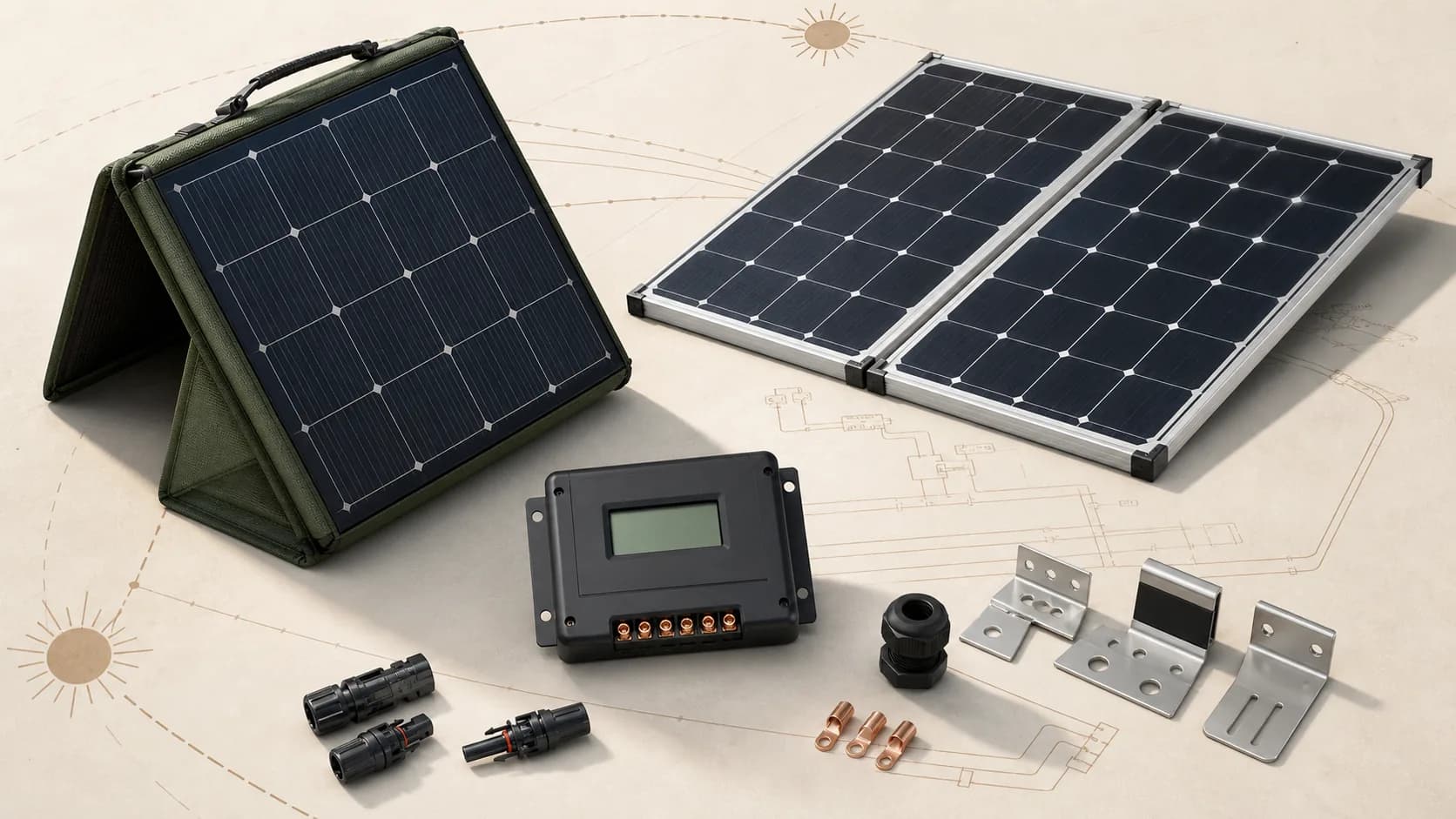
Best RV solar kits for roof, portable, and expandable setups
Panel watts are only the beginning. Available sun, shade, roof geometry, controller input limits, wiring, fusing, battery charge limits, and daily load decide whether a kit fits.
Original TowCheck editorial artwork. Generic equipment is shown; product-format diagrams below are not scale replicas.
01 · Start here
Three distinct fits, not a universal winner
Choose the operating pattern that resembles your setup, then verify every capacity and compatibility constraint.
01
roof
Best for A fixed roof array with MPPT and monitoring hardware
Renogy 400W 12V General Off-Grid Kit
The most complete fixed 400W starting point here when its panel layout and 40A controller limits fit the roof and battery bank.
Array
400W
Controller
Rover Li 40A MPPT
Important limit: A nominal kit cannot know your roof penetrations, cable route, combiner needs, battery fuse plan, disconnects, or local installation requirements.
Best for A smaller fixed RV kit with room on the controller
Go Power! Overlander 200
A tidy 200W fixed kit for modest energy budgets or roof-limited installations that value an RV-oriented package and a 30A controller.
Array
200W
Controller
30A Bluetooth PWM
Important limit: PWM yields less voltage-conversion flexibility than MPPT, and the manufacturer page presents differing expansion figures in its copy; verify the current manual before adding panels.
Best for High-output portable deployment around campsite shade
Renogy 400W Lightweight Portable Suitcase
The flexible choice when you need to park the RV in shade but move the array toward sun and can manage a large folding panel safely.
Array
400W
Controller
Optional bundle; verify selection
Important limit: It is a sizeable sail in wind, needs secure placement and theft/weather planning, and the controller is configuration-dependent rather than assumed in every package.
We favour documented constraints and reproducible setup over feature count. These pages do not represent hands-on laboratory testing unless explicitly stated.
01
Daily energy yield using realistic peak-sun hours, system losses, shade, season, and panel orientation.
02
Controller PV voltage/current limits at the coldest expected conditions and battery charge-current limits.
03
Roof structure/geometry or portable storage/deployment, plus cable routing, voltage drop, connectors, fusing, and disconnects.
04
Exact kit contents, expansion rules, component warranties, documentation, and serviceability.
04 · Product notes
Where each option fits—and where it does not
Each recommendation is conditional. The “avoid when” note matters as much as the feature list.
roof
Array
400W
Controller
Rover Li 40A MPPT
Format
Rigid roof array
Pick 1 · A fixed roof array with MPPT and monitoring hardware
Renogy 400W 12V General Off-Grid Kit
The most complete fixed 400W starting point here when its panel layout and 40A controller limits fit the roof and battery bank.
Why it fits
The current kit pairs 400W of rigid modules with a Rover Li 40A MPPT controller, BT-2 module, mounting hardware, cable, and protection components.
Strengths
MPPT controller included
Bluetooth module included
Useful fixed-array starting power
Tradeoffs
Roof penetrations and system protection still need design
Panel configuration can vary by kit revision
Compatibility check
Check actual panel count/revision, roof dimensions and structure, controller PV input limits at cold open-circuit voltage, battery voltage/chemistry, and cable run.
Avoid when
Roof shade or obstructions make a fixed array ineffective, or the controller cannot accept the planned series/parallel voltage and expansion.
Published limitation
A nominal kit cannot know your roof penetrations, cable route, combiner needs, battery fuse plan, disconnects, or local installation requirements.
Warranty record
Component-specific terms apply; confirm the current kit warranty schedule.
Pick 2 · A smaller fixed RV kit with room on the controller
Go Power! Overlander 200
A tidy 200W fixed kit for modest energy budgets or roof-limited installations that value an RV-oriented package and a 30A controller.
Why it fits
The reviewed page combines one 200W rigid module, a Bluetooth-capable 30A PWM controller, roof hardware, and cable in an RV-focused kit.
Strengths
Compact one-panel roof layout
RV-oriented kit
Controller offers some expansion headroom
Tradeoffs
PWM controller
Verify current expansion limit because page wording differs
Compatibility check
Confirm roof area, controller input/current limits, battery compatibility, cable distance, sealant/fastener method, and the exact expansion plan.
Avoid when
Shade, winter use, or a high daily energy budget requires more harvesting efficiency or substantially more array from the start.
Published limitation
PWM yields less voltage-conversion flexibility than MPPT, and the manufacturer page presents differing expansion figures in its copy; verify the current manual before adding panels.
Warranty record
Reviewed page lists 25 years for panel power output and five years for the controller.
Pick 3 · High-output portable deployment around campsite shade
Renogy 400W Lightweight Portable Suitcase
The flexible choice when you need to park the RV in shade but move the array toward sun and can manage a large folding panel safely.
Why it fits
The reviewed page lists 400W in a roughly 30-lb folding format, with optional controller-bundle choices and published electrical/folded dimensions.
Strengths
Move panel away from RV shade
High nominal portable output
Published folded size and electrical specs
Tradeoffs
Large panel to deploy and secure
Controller not assumed in every selection
Compatibility check
Match open-circuit voltage and current to the selected controller, limit extension-cable voltage drop, confirm connector polarity, and stay within the battery’s charge current.
Avoid when
You cannot store, carry, deploy, secure, and monitor a large portable array or need unattended charging.
Published limitation
It is a sizeable sail in wind, needs secure placement and theft/weather planning, and the controller is configuration-dependent rather than assumed in every package.
Warranty record
Three-year workmanship term on the reviewed product page.
Start with the energy model, then decide where the panel can reliably see sun.
05 · Selection method
How to make the final choice
A product page tells you what a component can do. Your measured setup determines whether it belongs in the system.
01
Model energy, not nameplate watts
A 400W array does not produce 400W all day. Use realistic sun hours, temperature, orientation, shade, wiring/controller loss, and battery acceptance.
02
Check cold open-circuit voltage
Panel voltage rises in cold weather. The series string’s corrected open-circuit voltage must remain below the controller’s PV input maximum.
03
Account for everything outside the box
Roof sealants, gland/entry hardware, structural backing, combiner/disconnects, overcurrent protection, cable support, battery fuse, and commissioning measurements may not be included.
Safety boundary
Before you install or operate
Cover or isolate panels while wiring; illuminated modules can produce voltage whenever light reaches them.
Use appropriately rated DC connectors, conductors, fuses/breakers, disconnects, and weatherproof entries.
Follow roof and RV manufacturer requirements for fastening, sealing, walkable areas, and cable routing.
Secure portable panels against wind and trip hazards, and never create an unprotected cable path through a campsite.
06 · Common questions
Questions to settle before checkout
How many watts of solar does an RV need?
Start with daily watt-hours and the worst season you expect to use. Then account for sun hours, losses, shade, battery charge limits, generator/shore alternatives, and a reserve for poor weather.
Is MPPT always necessary?
Not always, but MPPT generally offers more voltage/configuration flexibility and can harvest more energy under some conditions. A correctly sized PWM system can still suit a small 12V array and modest budget.
Can I add any panel later?
No. Added modules must be electrically compatible with the existing array and remain within controller voltage/current limits, including cold-voltage correction. Follow the controller and kit makers’ expansion rules.
Source record
Documents reviewed for this comparison
We prefer current manufacturer pages and manuals. A retailer is used where it is the clearest available record and is labeled as such.
Renogy 400W 12V General Off-Grid Kit
Last checked July 22, 2026
Renogy 400W General Off-Grid kit manufacturer · checked 2026-07-22Current panel configuration, controller, Bluetooth, hardware, and package contents.
Go Power! Overlander 200
Last checked July 22, 2026
Go Power! Overlander 200 kit manufacturer · checked 2026-07-22Panel/controller ratings, package contents, weight, expansion wording, and component warranty.