TOWCHECK FIELD GUIDE
How to size an RV inverter from documented loads
Size the shortlist from the loads that may run together, the largest documented startup event, required waveform and outlets, and the battery bank's supported DC current—not from daily watt-hours alone.
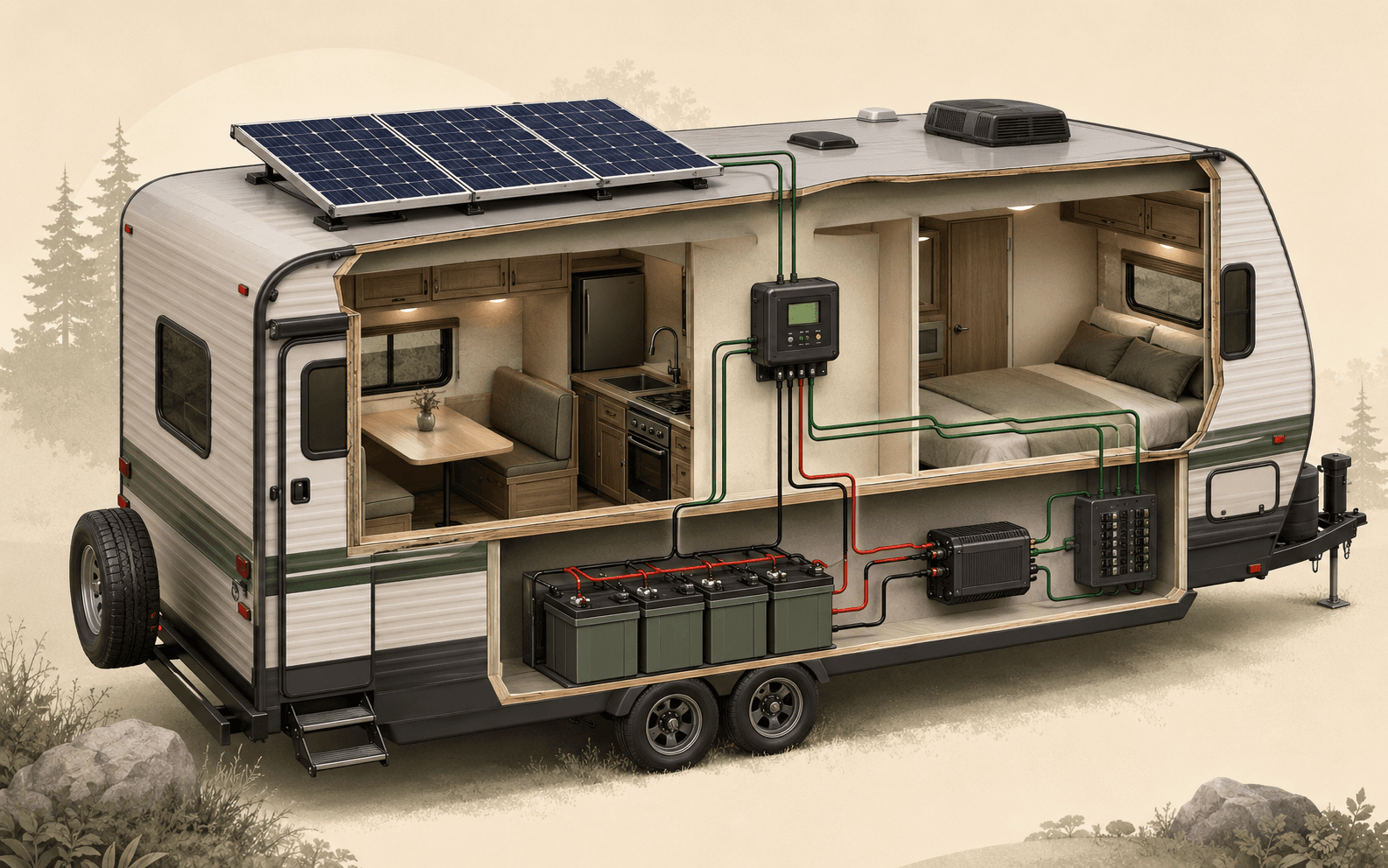
Battery energy, solar harvest and appliance demand are easier to compare when the whole system is visible.
What the terms mean
Continuous watts describe sustained AC output. Surge watts describe a short-duration event under the exact inverter instructions. Daily watt-hours size energy storage, while simultaneous running watts and startup behaviour size the inverter. At 12 V, even a moderate AC load can require high DC current after conversion losses, so the battery, BMS, conductors, terminals, fusing, disconnects, transfer arrangement, ventilation and installation environment must be designed as one system.
Worked example
Common mistakes
- Using daily watt-hours as though they were simultaneous inverter watts.
- Adding every appliance's startup number even when only the largest additional startup event is credible.
- Assuming a battery's amp-hour label proves that its BMS and terminals can support the inverter's DC current.
- Selecting cable and fuse sizes from a generic chart instead of the exact inverter manual, run length, installation method and applicable code.
- Back-feeding RV circuits or improvising neutral, ground, shore-power and transfer arrangements.
Frequently asked questions
Is a larger inverter always better?
No. A larger unit can increase idle consumption, DC current, conductor and protection requirements, cost and installation complexity. Choose from documented loads and the exact system constraints.
Can the inverter run an air conditioner?
Not universally. Running watts, compressor startup behaviour, temperature, voltage drop, waveform, any soft-start equipment, battery current limits and the inverter's surge duration all matter. Use appliance and inverter documentation or measured data.
Does TowCheck size the battery cables and fuse?
No. Current, cable length, conductor material, insulation, routing, allowable voltage drop, terminal ratings, protection and local requirements must be resolved from the exact equipment manuals and qualified design.
Should an inverter be installed as a DIY project?
This guide is not an installation instruction. Incorrect DC protection, cable termination, ventilation, bonding or transfer wiring can cause fire, equipment damage or shock. Use qualified help where required.
Primary references
These sources support terminology and general planning context. Use the current documentation for your exact vehicle, trailer and components.
- Renogy: RV inverter sizing considerations
- Victron Inverter Smart installation manual
- Victron Wiring Unlimited
- Transport Canada recall example: inverter back-feed risk
Continue with your own numbers
Start with the RV electrical load planner, carry daily energy to the battery runtime and solar sizing calculators, or return to the RV electrical planning hub.