TowCheck field guide · Off-grid power

Best RV lithium batteries by usable capacity and system fit

A lithium battery is a system component. The charger, converter, inverter, cabling, fusing, disconnects, alternator path, mounting environment, and battery-management limits all have to agree.

Source-reviewed 3 products compared
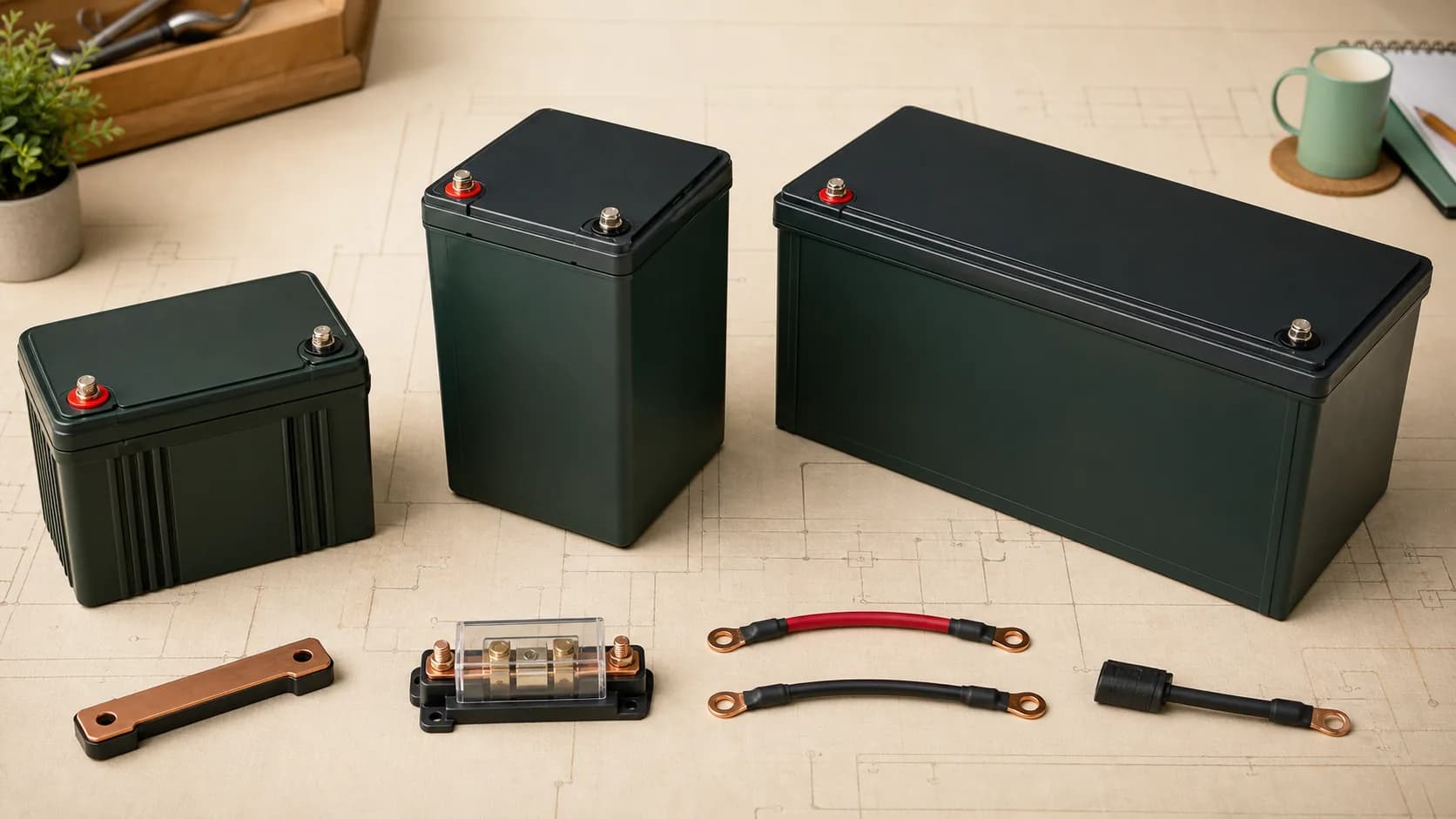
Generic lithium RV batteries with busbar, fuse, and heavy-gauge cable components on a warm technical bench
Original TowCheck editorial artwork. Generic equipment is shown; product-format diagrams below are not scale replicas.

01 · Start here

Three distinct fits, not a universal winner

Choose the operating pattern that resembles your setup, then verify every capacity and compatibility constraint.

01

Best for A documented 100Ah building block with long support coverage

Battle Born 100Ah 12V Smart

A premium 100Ah module for owners who value published current limits, cold-charge protection, domestic support, and a long written warranty.

Nominal energy
12V / 100Ah
Continuous output
100A continuous; 200A/30 sec

Important limit: A single 100Ah module may be undersized for high-power inverter loads; system current and parallel-bank rules still govern.

Read the fit notes View manufacturer detailsDestination: Battle Born Batteries or listed retailer
02

Best for Integrated heating and Bluetooth in a compact 100Ah format

Renogy 12V 100Ah Pro Smart Self-Heating

The feature-dense 100Ah option when cold-weather charging and phone-level battery visibility matter.

Nominal energy
12V / 100Ah
Continuous output
100A continuous; 245A/30 sec

Important limit: Heating consumes available charging energy and has activation conditions; app/BMS features do not remove the need for a system shunt or correct protection design.

Read the fit notes View manufacturer detailsDestination: Renogy or listed retailer
03

Best for Higher-capacity single-case RV banks

Epoch 12V 300Ah Essential Heated

The high-capacity option here for owners whose energy model and installation can use a 3.84kWh, 200A-class battery in one enclosure.

Nominal energy
12.8V / 300Ah (3.84kWh)
Continuous output
200A continuous; 400A/3 sec

Important limit: At roughly 58 lb, one case is substantial to position and secure. Current availability wording should be checked before planning an installation date.

Read the fit notes View manufacturer detailsDestination: Epoch Batteries or listed retailer

Calculate first

Estimate battery runtime before choosing capacity

Convert the loads you truly plan to run into daily watt-hours, then account for inverter loss, reserve, temperature, and charging opportunity.

Open calculator

02 · Comparison

Fit-critical specifications at a glance

Price markers are relative within this comparison, not live quotes. Use each product’s source record for current specifications and availability.

Focus:
Product specifications and fit comparison
ProductBest forNominal energyContinuous outputCold-charge strategyMonitoringRelative priceDetails
Battle Born 100Ah 12V SmartVerified 2026-07-22A documented 100Ah building block with long support coverage12V / 100Ah100A continuous; 200A/30 secLow-temperature protectionSmart model; verify current app details$$$$Deep dive
Renogy 12V 100Ah Pro Smart Self-HeatingVerified 2026-07-22Integrated heating and Bluetooth in a compact 100Ah format12V / 100Ah100A continuous; 245A/30 secAutomatic self-heatingBluetooth$$$Deep dive
Epoch 12V 300Ah Essential HeatedVerified 2026-07-22Higher-capacity single-case RV banks12.8V / 300Ah (3.84kWh)200A continuous; 400A/3 secIntegrated heatingBluetooth$$$$Deep dive

A documented 100Ah building block with long support coverage

Battle Born 100Ah 12V Smart

Nominal energy
12V / 100Ah
Continuous output
100A continuous; 200A/30 sec
Cold-charge strategy
Low-temperature protection
Monitoring
Smart model; verify current app details
Relative price
$$$$
Read the deep dive

Integrated heating and Bluetooth in a compact 100Ah format

Renogy 12V 100Ah Pro Smart Self-Heating

Nominal energy
12V / 100Ah
Continuous output
100A continuous; 245A/30 sec
Cold-charge strategy
Automatic self-heating
Monitoring
Bluetooth
Relative price
$$$
Read the deep dive

Higher-capacity single-case RV banks

Epoch 12V 300Ah Essential Heated

Nominal energy
12.8V / 300Ah (3.84kWh)
Continuous output
200A continuous; 400A/3 sec
Cold-charge strategy
Integrated heating
Monitoring
Bluetooth
Relative price
$$$$
Read the deep dive

03 · How we evaluated

The criteria behind the short list

We favour documented constraints and reproducible setup over feature count. These pages do not represent hands-on laboratory testing unless explicitly stated.

  1. 01

    Daily watt-hour requirement, inverter surge, and expected charging window—not amp-hours alone.

  2. 02

    BMS continuous/peak current, low-temperature behaviour, configuration limits, and recovery procedure.

  3. 03

    Installed fuse, conductor, busbar, disconnect, charger, converter, inverter, and alternator compatibility.

  4. 04

    Enclosure dimensions, mass, restraint, ventilation guidance, ingress rating, service access, and warranty.

04 · Product notes

Where each option fits—and where it does not

Each recommendation is conditional. The “avoid when” note matters as much as the feature list.

Nominal energy
12V / 100Ah
Continuous output
100A continuous; 200A/30 sec
Cold-charge strategy
Low-temperature protection

Pick 1 · A documented 100Ah building block with long support coverage

Battle Born 100Ah 12V Smart

A premium 100Ah module for owners who value published current limits, cold-charge protection, domestic support, and a long written warranty.

Why it fits

The reviewed page/cut sheet publish 100A continuous output, 200A surge for 30 seconds, low-temperature protection, cycle guidance, and a ten-year warranty.

Strengths

  • Published current limits
  • Cold-charge protection
  • Ten-year warranty

Tradeoffs

  • Premium cost per nominal kWh
  • One module may not support large inverter loads
Compatibility check
Confirm the exact Smart model’s monitoring, charger profile, series/parallel rules, terminal hardware, and installed fuse/cable sizing.
Avoid when
The daily energy model calls for a much larger bank and multiple small modules would add unnecessary cabling and cost.
Published limitation
A single 100Ah module may be undersized for high-power inverter loads; system current and parallel-bank rules still govern.
Warranty record
Ten years in the reviewed manufacturer material.
Nominal energy
12V / 100Ah
Continuous output
100A continuous; 245A/30 sec
Cold-charge strategy
Automatic self-heating

Pick 2 · Integrated heating and Bluetooth in a compact 100Ah format

Renogy 12V 100Ah Pro Smart Self-Heating

The feature-dense 100Ah option when cold-weather charging and phone-level battery visibility matter.

Why it fits

The current product page combines self-heating, Bluetooth, IP67 construction, a 100A continuous limit, and published surge/cycle figures.

Strengths

  • Integrated heating
  • Bluetooth monitoring
  • IP67 rating on reviewed page

Tradeoffs

  • Heating depends on temperature and charge-current conditions
  • Warranty terms should be confirmed for market and seller
Compatibility check
Verify charger settings, available charge current for the heater, enclosure/mounting environment, and series/parallel rules for the exact revision.
Avoid when
Your charging source cannot meet the heater activation requirements or the installation needs more than 100A from one module.
Published limitation
Heating consumes available charging energy and has activation conditions; app/BMS features do not remove the need for a system shunt or correct protection design.
Warranty record
Reviewed product material lists seven years; confirm market-specific written terms.
Nominal energy
12.8V / 300Ah (3.84kWh)
Continuous output
200A continuous; 400A/3 sec
Cold-charge strategy
Integrated heating

Pick 3 · Higher-capacity single-case RV banks

Epoch 12V 300Ah Essential Heated

The high-capacity option here for owners whose energy model and installation can use a 3.84kWh, 200A-class battery in one enclosure.

Why it fits

The current page publishes 300Ah/3.84kWh, 200A continuous output, heating, Bluetooth, configuration limits, and an eleven-year warranty.

Strengths

  • Large single-case energy
  • 200A continuous output
  • Eleven-year listed warranty

Tradeoffs

  • Heavy single enclosure
  • Verify current availability before scheduling work
Compatibility check
Confirm physical dimensions, support structure, lifting/handling plan, charger/inverter current, fuse interrupt rating, cable size, and 4S4P configuration limits.
Avoid when
The compartment cannot safely support or service the enclosure, or a modular bank would provide better placement and redundancy.
Published limitation
At roughly 58 lb, one case is substantial to position and secure. Current availability wording should be checked before planning an installation date.
Warranty record
Eleven years on the reviewed product page.

Decision tool

Match the battery architecture to the load

Calculate energy and current first; this selector only helps organize the remaining tradeoffs.

01What bank shape does the energy model suggest?
02Which secondary requirement is strongest?

05 · Selection method

How to make the final choice

A product page tells you what a component can do. Your measured setup determines whether it belongs in the system.

01

Separate energy from power

Watt-hours determine how long loads can run; amps and surge duration determine whether the battery/BMS can start and sustain them. Both tests must pass.

02

Audit every charging source

A shore converter, solar controller, inverter/charger, tow-vehicle alternator path, and portable charger may each need a lithium-compatible profile and current limit.

03

Design fault protection

Place correctly rated overcurrent protection close to the energy source, size conductors for current and voltage drop, and use components with adequate DC interrupt ratings.

Safety boundary

Before you install or operate

  • Battery work can deliver extremely high fault current. Use qualified design/installation when you are not trained for DC power systems.
  • Follow the battery and equipment makers’ instructions for fusing, cable size, torque, charging, mounting, temperature, and configuration.
  • Do not install a battery where the enclosure rating, restraint, clearance, or service access is inadequate.
  • A BMS is not a substitute for branch protection, a main fuse, correct cable routing, or an emergency disconnect.

06 · Common questions

Questions to settle before checkout

Can I drop a lithium battery into an RV without other changes?

Sometimes the physical swap is simple, but compatibility still has to be confirmed for the converter, solar controller, alternator charging path, inverter, monitor, fusing, cables, and temperature environment.

Does a 100Ah lithium battery run any 2,000W inverter?

No. A 2,000W AC load can demand well above 150A DC after losses. Check the battery/BMS continuous and surge current, bank configuration, cabling, fusing, and inverter instructions.

Can LiFePO4 batteries charge below freezing?

Only when the exact battery permits it. Some block charging, some include heaters, and activation conditions vary. Follow the battery’s documented temperature limits.

Source record

Documents reviewed for this comparison

We prefer current manufacturer pages and manuals. A retailer is used where it is the clearest available record and is labeled as such.

Renogy 12V 100Ah Pro Smart Self-Heating

Last checked July 22, 2026

Epoch 12V 300Ah Essential Heated

Last checked July 22, 2026