TowCheck field guide · Backup power

Best portable RV generators by load, fuel, and campsite workflow

Choose from measured running and starting loads. A carbon-monoxide shutoff is a backup feature—not permission to run any generator inside or near an occupied RV, garage, compartment, or opening.

Source-reviewed 3 products compared
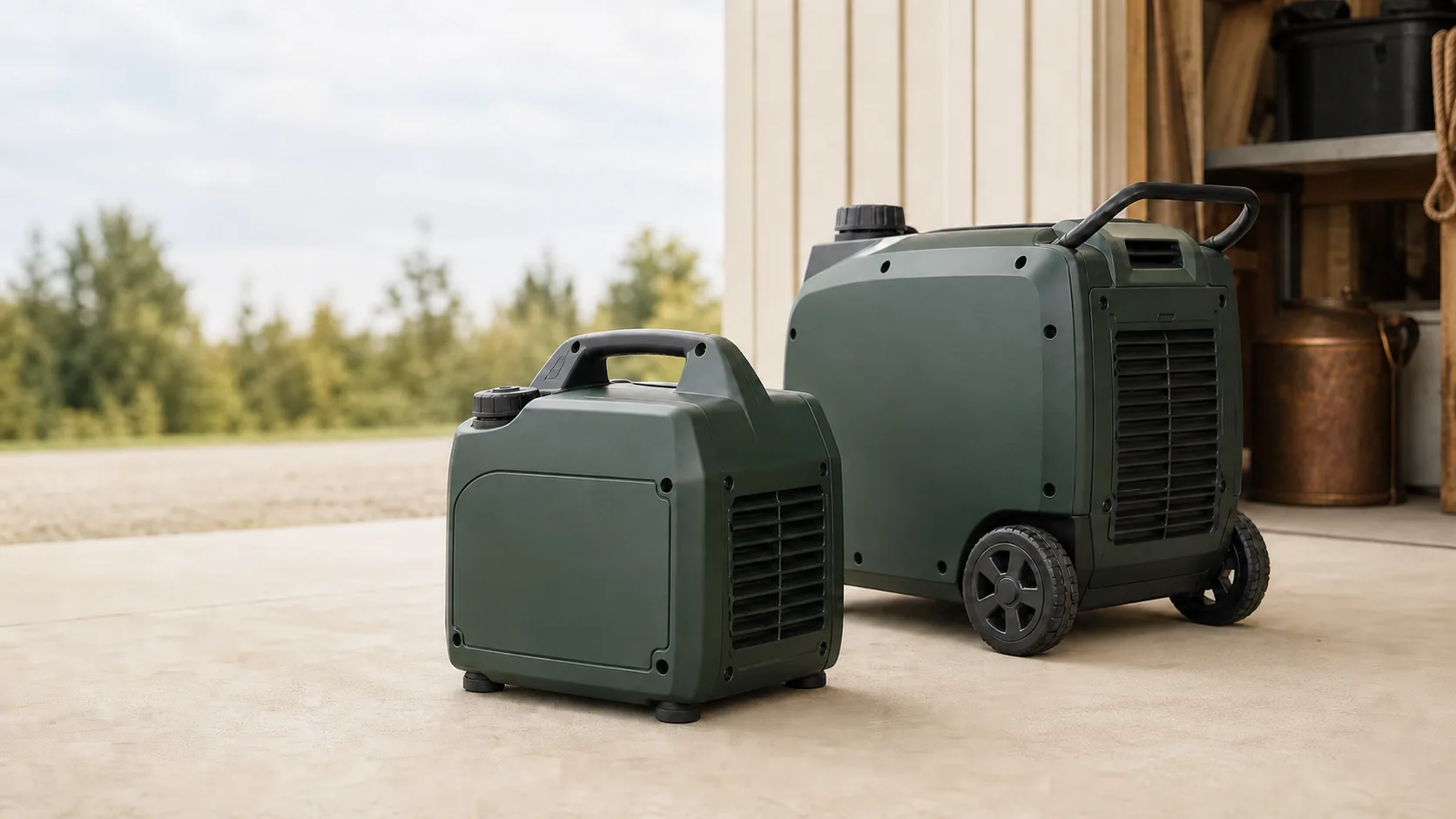
Two generic enclosed portable inverter generators shown from a plain rear-side angle without branding or controls
Original TowCheck editorial artwork. Generic equipment is shown; product-format diagrams below are not scale replicas.

01 · Start here

Three distinct fits, not a universal winner

Choose the operating pattern that resembles your setup, then verify every capacity and compatibility constraint.

01

Best for Refined compact gasoline power and service network

Honda EU2200i

The premium compact benchmark when 1,800 running watts fits the load plan and low carried mass matters more than maximum RV output.

Output
2,200 max / 1,800 rated W
Fuel
Gasoline

Important limit: A single unit may not start every RV air conditioner or support overlapping high-draw loads. It does not provide the output of the larger Champion class.

Read the fit notes View manufacturer detailsDestination: Honda or listed retailer
02

Best for Compact RV-ready receptacle and straightforward controls

Yamaha EF2200iS

A strong compact alternative when the RV-ready 30A receptacle and Yamaha feature set fit, with output similar to the Honda but more carried mass.

Output
2,200 peak / 1,800 rated W
Fuel
Gasoline

Important limit: At 55.2 lb it is heavier than the Honda, and its 1,800 running watts still demands deliberate load management.

Read the fit notes View manufacturer detailsDestination: Yamaha or listed retailer
03

Best for More RV output and dual-fuel flexibility

Champion 4,500W Dual-Fuel Inverter (201319)

The practical high-output option here when a much heavier generator is acceptable and you want a TT-30R outlet plus gasoline/propane operation.

Output
Gas: 4,500 start / 3,500 run W
Fuel
Gasoline or propane

Important limit: It is a different portability class than the two 2,200W units. Fuel choice changes output, and no generator should be treated as silent at a campsite.

Read the fit notes View manufacturer detailsDestination: Champion Power Equipment or listed retailer

Calculate first

Add running and starting loads before choosing output

Air conditioners, converters, microwaves, pumps, and refrigerators can overlap. Model the operating sequence you will actually use.

Open calculator

02 · Comparison

Fit-critical specifications at a glance

Price markers are relative within this comparison, not live quotes. Use each product’s source record for current specifications and availability.

Focus:
Product specifications and fit comparison
ProductBest forOutputFuelNoise claimRuntime claimRelative priceDetails
Honda EU2200iVerified 2026-07-22Refined compact gasoline power and service network2,200 max / 1,800 rated WGasoline48–57 dBAUp to 8.1 hr at 1/4 load$$$$Deep dive
Yamaha EF2200iSVerified 2026-07-22Compact RV-ready receptacle and straightforward controls2,200 peak / 1,800 rated WGasoline57–65 dBA10.5 hr at 1/4 load$$$$Deep dive
Champion 4,500W Dual-Fuel Inverter (201319)Verified 2026-07-22More RV output and dual-fuel flexibilityGas: 4,500 start / 3,500 run WGasoline or propane61 dBA claim14 hr gas / 21 hr propane at 1/4 load$$$Deep dive

Refined compact gasoline power and service network

Honda EU2200i

Output
2,200 max / 1,800 rated W
Fuel
Gasoline
Noise claim
48–57 dBA
Runtime claim
Up to 8.1 hr at 1/4 load
Relative price
$$$$
Read the deep dive

Compact RV-ready receptacle and straightforward controls

Yamaha EF2200iS

Output
2,200 peak / 1,800 rated W
Fuel
Gasoline
Noise claim
57–65 dBA
Runtime claim
10.5 hr at 1/4 load
Relative price
$$$$
Read the deep dive

More RV output and dual-fuel flexibility

Champion 4,500W Dual-Fuel Inverter (201319)

Output
Gas: 4,500 start / 3,500 run W
Fuel
Gasoline or propane
Noise claim
61 dBA claim
Runtime claim
14 hr gas / 21 hr propane at 1/4 load
Relative price
$$$
Read the deep dive

03 · How we evaluated

The criteria behind the short list

We favour documented constraints and reproducible setup over feature count. These pages do not represent hands-on laboratory testing unless explicitly stated.

  1. 01

    Measured running watts and the largest credible starting event, including converter charging and overlapping loads.

  2. 02

    Fuel availability/storage, output derating on propane or at altitude, runtime, service access, and maintenance.

  3. 03

    Dry/operating mass, dimensions, lift points, transport restraint, weather protection, and campsite noise rules.

  4. 04

    Receptacles, adapters, bonding/grounding instructions, surge-protector compatibility, CO shutoff, support, and warranty.

04 · Product notes

Where each option fits—and where it does not

Each recommendation is conditional. The “avoid when” note matters as much as the feature list.

Output
2,200 max / 1,800 rated W
Fuel
Gasoline
Noise claim
48–57 dBA

Pick 1 · Refined compact gasoline power and service network

Honda EU2200i

The premium compact benchmark when 1,800 running watts fits the load plan and low carried mass matters more than maximum RV output.

Why it fits

Honda publishes 2,200 maximum/1,800 rated watts, 48–57 dBA operation, 47.4-lb dry weight, CO-MINDER, Bluetooth monitoring, parallel capability, and a three-year residential warranty.

Strengths

  • Low dry weight for the class
  • Bluetooth and CO-MINDER
  • Three-year residential warranty

Tradeoffs

  • Premium price
  • Limited headroom for large RV load combinations
Compatibility check
Confirm the required receptacle/adapter, neutral/ground and surge-protector behaviour, altitude derating, fuel storage, and every load’s measured start/run demand.
Avoid when
Your verified simultaneous running or starting demand exceeds the unit’s ratings, or you require dual fuel or an integrated RV TT-30 receptacle.
Published limitation
A single unit may not start every RV air conditioner or support overlapping high-draw loads. It does not provide the output of the larger Champion class.
Warranty record
Three-year residential warranty on the reviewed model page.
Output
2,200 peak / 1,800 rated W
Fuel
Gasoline
Noise claim
57–65 dBA

Pick 2 · Compact RV-ready receptacle and straightforward controls

Yamaha EF2200iS

A strong compact alternative when the RV-ready 30A receptacle and Yamaha feature set fit, with output similar to the Honda but more carried mass.

Why it fits

Yamaha publishes 2,200 peak/1,800 rated watts, an RV-ready 30A outlet, CO sensor, parallel capability, 10.5-hour quarter-load runtime, and three-year warranty.

Strengths

  • RV-ready 30A receptacle
  • CO sensor and parallel capability
  • Long published quarter-load runtime

Tradeoffs

  • Heavier than the Honda
  • Still requires active load management
Compatibility check
Confirm receptacle/adapter needs, air-conditioner starting behaviour, elevation/temperature derating, storage, maintenance access, and measured load sequence.
Avoid when
The RV load model requires substantially more continuous output or dual-fuel flexibility.
Published limitation
At 55.2 lb it is heavier than the Honda, and its 1,800 running watts still demands deliberate load management.
Warranty record
Three years on the reviewed manufacturer specifications.
Output
Gas: 4,500 start / 3,500 run W
Fuel
Gasoline or propane
Noise claim
61 dBA claim

Pick 3 · More RV output and dual-fuel flexibility

Champion 4,500W Dual-Fuel Inverter (201319)

The practical high-output option here when a much heavier generator is acceptable and you want a TT-30R outlet plus gasoline/propane operation.

Why it fits

The reviewed page lists 4,500 starting/3,500 running watts on gasoline, 3,150 running watts on propane, 61 dBA, electric start, CO Shield, parallel capability, and a three-year warranty.

Strengths

  • Higher RV running output
  • Dual fuel and TT-30R
  • Electric start and CO Shield

Tradeoffs

  • Substantially larger portability burden
  • Lower output on propane
Compatibility check
Confirm exact model 201319, propane-regulator setup, receptacles, neutral/ground and surge-protector behaviour, altitude derating, storage, and measured load sequence.
Avoid when
One-person lifting/compact storage is essential or campsite rules, neighbour distance, and operating hours make a larger generator impractical.
Published limitation
It is a different portability class than the two 2,200W units. Fuel choice changes output, and no generator should be treated as silent at a campsite.
Warranty record
Three-year limited warranty on the reviewed product page.

Decision tool

Match output to the operating plan

This selector assumes you have already listed running watts and starting events.

01Which verified output class is closer?
02Which secondary trait matters most?

05 · Selection method

How to make the final choice

A product page tells you what a component can do. Your measured setup determines whether it belongs in the system.

01

List simultaneous loads

A converter can draw heavily while charging, and thermostatic loads can restart unexpectedly. Build a switching sequence and include the largest starting event.

02

Plan transport and operation separately

A generator needs secure, upright transport and a stable outdoor operating location protected as the manual allows—never an enclosed cargo or generator compartment unless specifically engineered and approved for that equipment.

03

Read the electrical instructions

RV surge protectors and some equipment respond differently to neutral/ground arrangements. Follow both generator and RV equipment guidance rather than improvising a bonding plug or ground connection.

Safety boundary

Before you install or operate

  • Operate portable generators only outdoors, far from doors, windows, vents, neighbouring occupied spaces, and combustible materials, with exhaust directed away.
  • Never run a generator in an RV, garage, shed, enclosed compartment, under an awning, or in any partly enclosed space.
  • Install and test carbon-monoxide alarms in the RV. A generator’s CO shutoff is a backup, not a substitute for placement and alarms.
  • Allow cooling before refuelling or storage; follow fuel-container, propane, grounding, weather, extension-cord, and maintenance instructions.

06 · Common questions

Questions to settle before checkout

Will a 2,200W generator run an RV air conditioner?

Sometimes, but not universally. Compressor starting demand, altitude, temperature, soft-start equipment, converter load, and other simultaneous loads all matter. Use measured or manufacturer-supplied start/run data.

Is propane output the same as gasoline output?

Often not. The Champion model here lists lower running output on propane. Use the rating for the fuel you will actually operate.

Can I run a generator beneath an RV awning in rain?

No. An awning does not make an unsafe location safe and can trap exhaust. Follow the generator maker’s weather guidance while keeping the unit outdoors and far from openings and occupied spaces.

Source record

Documents reviewed for this comparison

We prefer current manufacturer pages and manuals. A retailer is used where it is the clearest available record and is labeled as such.

Honda EU2200i

Last checked July 22, 2026

  • Honda EU2200i model page manufacturer · checked 2026-07-22Output, noise, mass, runtime, CO-MINDER, Bluetooth, parallel capability, and warranty.

Champion 4,500W Dual-Fuel Inverter (201319)

Last checked July 22, 2026