Best weight distribution hitches by fit and adjustment method
A weight distribution hitch must be allowed by the tow vehicle and trailer makers, sized to the real loaded tongue weight, and adjusted from measured axle or fender-height results.
Best for Lower component mass and chain-based adjustment
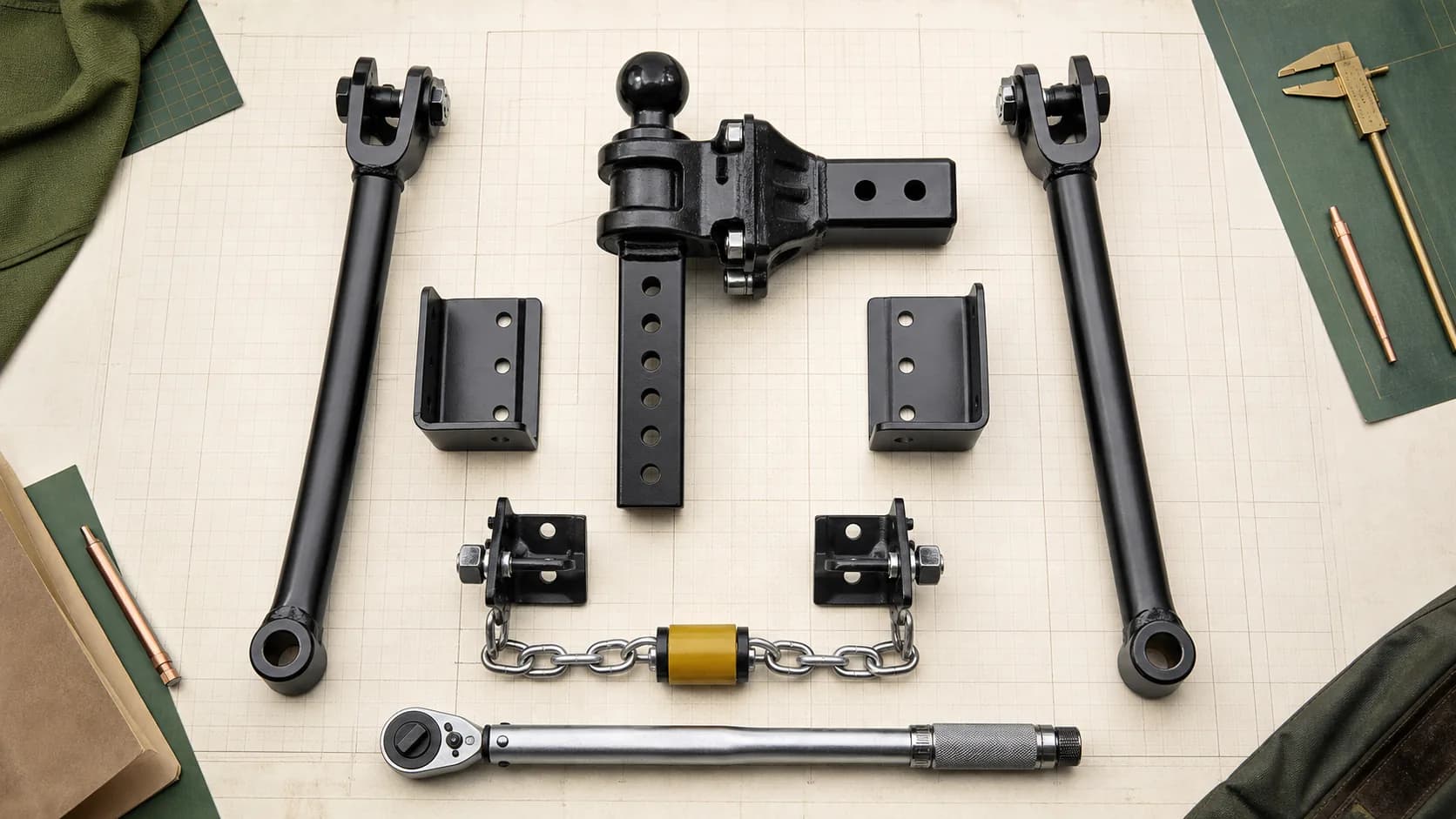
Andersen Weight Distribution Hitch
The distinct option for owners prioritizing lower carried weight and a chain/friction-cone design—provided the exact ball, receiver, bracket, and rating configuration fits.
Reviewed configuration
Configuration-dependent; up to 16k/1.6k
Sway approach
Friction cone
Important limit: The headline maximum applies only to appropriate configurations. Frame geometry and bracket type need more up-front selection than a single universal SKU suggests.
We favour documented constraints and reproducible setup over feature count. These pages do not represent hands-on laboratory testing unless explicitly stated.
01
A rating range that contains the measured loaded tongue weight and trailer weight.
02
Written permission and limits from the tow vehicle, receiver, and trailer manufacturers.
An adjustment method that can be verified by the vehicle maker’s specified measurement or scale passes.
04 · Product notes
Where each option fits—and where it does not
Each recommendation is conditional. The “avoid when” note matters as much as the feature list.
four point
Reviewed configuration
10,000 GTW / 1,000 TW
Sway approach
4-point integrated friction
Receiver
Model/shank dependent
Pick 1 · Integrated friction sway control with established setup documentation
Equal-i-zer 4-Point 10K
The conventional benchmark when a 10,000/1,000-lb configuration correctly brackets the loaded trailer and the tow vehicle permits this hitch type.
Why it fits
Its head and L-brackets provide four friction points, while the manufacturer publishes detailed installation, adjustment, maintenance, and rating instructions.
Strengths
Integrated sway resistance
Detailed factory manual
Multiple ratings across the product family
Tradeoffs
Heavy components
Fit and adjustment require precision
Compatibility check
The reviewed 90-00-1000 configuration is rated to 10,000 lb trailer weight and 1,000 lb tongue weight. Confirm shank rise/drop and receiver size for the exact kit.
Avoid when
The tow vehicle prohibits weight distribution, the loaded tongue weight falls outside the chosen model’s range, or trailer-frame components obstruct the brackets.
Published limitation
The steel system is heavy, noisy friction is normal, and correct socket/head/bracket setup takes careful work.
Warranty record
Limited lifetime warranty in the reviewed manufacturer material.
Pick 3 · Lower component mass and chain-based adjustment
Andersen Weight Distribution Hitch
The distinct option for owners prioritizing lower carried weight and a chain/friction-cone design—provided the exact ball, receiver, bracket, and rating configuration fits.
Why it fits
Andersen lists the assembled system under 60 lb and offers several receiver, ball, bracket, and rating configurations.
Strengths
Under 60 lb stated assembled weight
Grease-free ball and chain adjustment
Wide receiver/bracket selection
Tradeoffs
Rating varies materially by configuration
Urethane spring and friction-cone service terms differ
Compatibility check
Bumper-pull trailers only. The current fit guide separates configurations by ball size, receiver, rating, frame size, bracket style, and rise/drop.
Avoid when
You cannot positively identify the required configuration or the tow/trailer maker does not allow this type of weight distribution.
Published limitation
The headline maximum applies only to appropriate configurations. Frame geometry and bracket type need more up-front selection than a single universal SKU suggests.
Warranty record
Manufacturer FAQ states lifetime friction-cone coverage; verify coverage for all other components.
This selector identifies a direction to investigate; it cannot approve a hitch/vehicle/trailer combination.
05 · Selection method
How to make the final choice
A product page tells you what a component can do. Your measured setup determines whether it belongs in the system.
01
Size from loaded tongue weight
Include trailer cargo and any cargo carried behind the tow vehicle’s rear axle as directed by the hitch maker. Too-stiff spring bars are not a substitute for correct sizing.
02
Measure the trailer frame and coupler
Record coupler orientation, frame depth/width, available bracket distance, obstructions, receiver opening, and required rise/drop before choosing a configuration.
03
Verify restoration
Follow the tow vehicle maker’s specified front-axle-load or fender-height restoration target. More tension is not automatically better.
Safety boundary
Before you install or operate
Confirm that the tow vehicle, receiver, trailer frame, and coupler permit weight distribution.
Never exceed the lowest rating in the vehicle, hitch, ball, shank, receiver, trailer, axle, wheel, or tire system.
Follow the hitch maker’s lubrication, inspection, torque, backing, and maintenance instructions.
Integrated sway resistance does not correct poor loading, inadequate tongue weight, excessive speed, tire issues, or an incompatible tow vehicle.
06 · Common questions
Questions to settle before checkout
Does a weight distribution hitch increase towing capacity?
No. It does not raise the tow vehicle, receiver, axle, tire, or trailer ratings. It redistributes some load through spring forces when the vehicle and hardware permit it.
Should spring bars match the trailer’s dry tongue weight?
Use the hitch maker’s sizing method and loaded tongue weight, including applicable cargo behind the tow vehicle’s rear axle. Dry brochure values omit real travel load.
Is built-in sway control enough by itself?
No device replaces correct loading, suitable tongue weight, tire condition, speed, and an adequately matched vehicle/trailer combination.
Source record
Documents reviewed for this comparison
We prefer current manufacturer pages and manuals. A retailer is used where it is the clearest available record and is labeled as such.