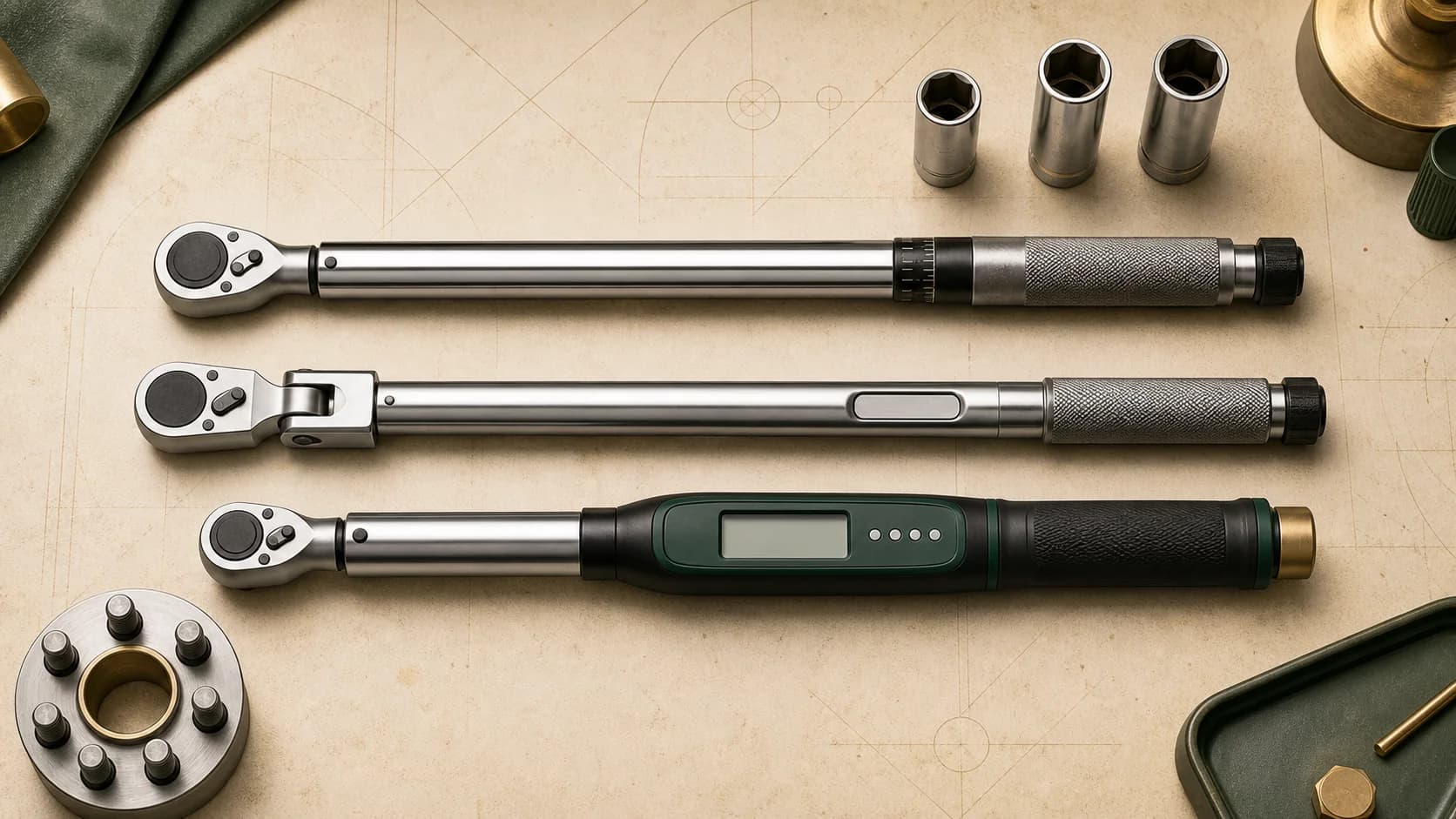
Original TowCheck editorial artwork. Generic equipment is shown; product-format diagrams below are not scale replicas.
01 · Start here
Three distinct fits, not a universal winner
Choose the operating pattern that resembles your setup, then verify every capacity and compatibility constraint.
01
micrometer click
Best for A broad-range mechanical wrench with dual-direction accuracy
TEKTON TRQ52403
The conventional micrometer choice when the documented wheel-fastener value sits comfortably inside its 40–300 ft-lb range and a 26.1-inch handle fits the work area.
Published range
40–300 ft-lb
Stated accuracy
±3% CW and CCW
Important limit: The handle must be returned to its lowest marked setting for storage, and the tool must not be used to break fasteners loose. A click can be missed with poor technique.
Best for A mechanical split-beam wrench that need not be turned down after use
Precision Instruments C3FR250F
The split-beam option when a 40–250 lb-ft range, 5 lb-ft increments, flex head, and no-turn-down storage procedure match the service plan.
Published range
40–250 lb-ft
Stated accuracy
Within 4%, 20–100% of scale
Important limit: Its 5 lb-ft scale is coarser than the TEKTON’s, and the published accuracy statement applies from 20% of full scale to full scale—not below that band.
Best for Electronic feedback and multiple torque units
GEARWRENCH 85077
The electronic option when visual, audible, and vibration alerts improve the workflow and its 25–250 ft-lb range contains the documented fastener value.
Published range
25–250 ft-lb
Stated accuracy
±2% CW / ±3% CCW, 20–100%
Important limit: It depends on three AAA batteries, and electronic alerts do not correct poor socket fit, side loading, a moving operator, or an unknown torque specification.
Torque is one part of wheel safety. Verify measured load, tire capacity, wheel capacity, inflation, fastener specification, tightening sequence, and recheck interval together.
We favour documented constraints and reproducible setup over feature count. These pages do not represent hands-on laboratory testing unless explicitly stated.
01
A documented torque range that places the required fastener value well inside the tool’s effective accuracy band.
02
Direction-specific accuracy statement, resolution, ratchet/socket geometry, usable handle length, and feedback that can be recognized in the actual work position.
Current written warranty and calibration coverage, including exclusions for misuse, overload, damage, or abnormal service.
04 · Product notes
Where each option fits—and where it does not
Each recommendation is conditional. The “avoid when” note matters as much as the feature list.
micrometer click
Published range
40–300 ft-lb
Stated accuracy
±3% CW and CCW
Feedback
Mechanical click
Pick 1 · A broad-range mechanical wrench with dual-direction accuracy
TEKTON TRQ52403
The conventional micrometer choice when the documented wheel-fastener value sits comfortably inside its 40–300 ft-lb range and a 26.1-inch handle fits the work area.
Why it fits
TEKTON publishes clockwise and counter-clockwise accuracy, scale increments, standards, dimensions, included calibration certificate, and the required storage procedure.
Strengths
Wide published range
Dual-direction specification
Certificate and case included
Tradeoffs
Must be turned down for storage
Longer tool needs clearance
Compatibility check
Use a correct 1/2-inch-drive socket and only for a specified value within 40–300 ft-lb; confirm the fastener procedure and whether extensions or adapters alter the setup.
Avoid when
The required value is close to or outside the range, access prevents a smooth pull from the handle centre, or you need electronic logging/feedback.
Published limitation
The handle must be returned to its lowest marked setting for storage, and the tool must not be used to break fasteners loose. A click can be missed with poor technique.
Warranty record
TEKTON’s reviewed warranty material states no time limits and covers tools in the U.S. and Canada, subject to its written exclusions and claim process.
Pick 2 · A mechanical split-beam wrench that need not be turned down after use
Precision Instruments C3FR250F
The split-beam option when a 40–250 lb-ft range, 5 lb-ft increments, flex head, and no-turn-down storage procedure match the service plan.
Why it fits
The maker publishes range, increment, length, mass, flex-head format, effective accuracy band, adjustment method, and operating instructions.
Strengths
No turn-down required after use
Flex head
Simple pull-out setting knob
Tradeoffs
5 lb-ft increments
Published warranty is one year
Compatibility check
Use a 1/2-inch-drive socket at a documented value within its effective range, with enough arc and handle clearance for a steady pull.
Avoid when
The required value needs finer resolution, falls below the documented effective band, or audible/visual electronic feedback is necessary.
Published limitation
Its 5 lb-ft scale is coarser than the TEKTON’s, and the published accuracy statement applies from 20% of full scale to full scale—not below that band.
Warranty record
Precision Instruments’ reviewed warranty statement covers defects in workmanship and materials for one year; calibration after abnormal use is excluded.
Pick 3 · Electronic feedback and multiple torque units
GEARWRENCH 85077
The electronic option when visual, audible, and vibration alerts improve the workflow and its 25–250 ft-lb range contains the documented fastener value.
Use a correct 1/2-inch-drive socket at a documented value in range; this is the non-angle model, so do not assume torque-angle capability.
Avoid when
You prefer a battery-free field tool, the required value is outside the range, or an electronic tool cannot be stored and serviced appropriately.
Published limitation
It depends on three AAA batteries, and electronic alerts do not correct poor socket fit, side loading, a moving operator, or an unknown torque specification.
Warranty record
The reviewed product page states a one-year limited warranty and 90-day calibration warranty; confirm registration, exclusions, and current regional service terms.
Find the exact fastener specification first. This selector does not supply or validate a torque value.
05 · Selection method
How to make the final choice
A product page tells you what a component can do. Your measured setup determines whether it belongs in the system.
01
Find the controlling specification
Use the current trailer, axle, wheel, hub, or fastener documentation for the exact assembly. Do not substitute a generic internet chart when the manufacturer specifies a value, pattern, condition, or recheck interval.
02
Keep the target away from the edge
Choose a wrench whose documented accuracy band comfortably contains the target. Confirm units twice and use a socket that fully seats without an improvised adapter stack.
03
Plan the entire wheel procedure
Seat components cleanly, follow the specified sequence and stages, lower/load/recheck exactly as instructed, and record the torque and recheck mileage or time.
Safety boundary
Before you install or operate
Never use a torque wrench as a breaker bar, hammer, pry tool, or substitute for a correctly rated lifting/support system.
Support the trailer with rated equipment on stable ground; never work beneath a trailer supported only by a jack.
Stop pulling immediately at the tool’s documented indication and keep force centred on the designated handle area.
A wrench that is dropped, overloaded, damaged, stored incorrectly, or giving implausible results may need inspection and calibration before further use.
06 · Common questions
Questions to settle before checkout
What torque should trailer lug nuts use?
There is no safe universal answer. Use the current specification and procedure for the exact axle, hub, wheel, stud, nut, and installation condition, including any staged tightening and recheck interval.
Can I loosen lug nuts with a torque wrench?
Not unless the exact manual explicitly permits that use. The three reviewed manuals treat these as measuring/tightening tools, not breaker bars.
Does a new torque wrench need calibration?
Review the supplied certificate and inspect the tool before use. Calibration interval depends on maker guidance, cycles, time, storage, drops, overload, and the accuracy required by the work.
Source record
Documents reviewed for this comparison
We prefer current manufacturer pages and manuals. A retailer is used where it is the clearest available record and is labeled as such.
TEKTON TRQ52403
Last checked July 22, 2026
TEKTON TRQ52403 product specifications manufacturer · checked 2026-07-22Range, increments, direction, accuracy, standards, dimensions, mass, included case/manual, and calibration certificate.