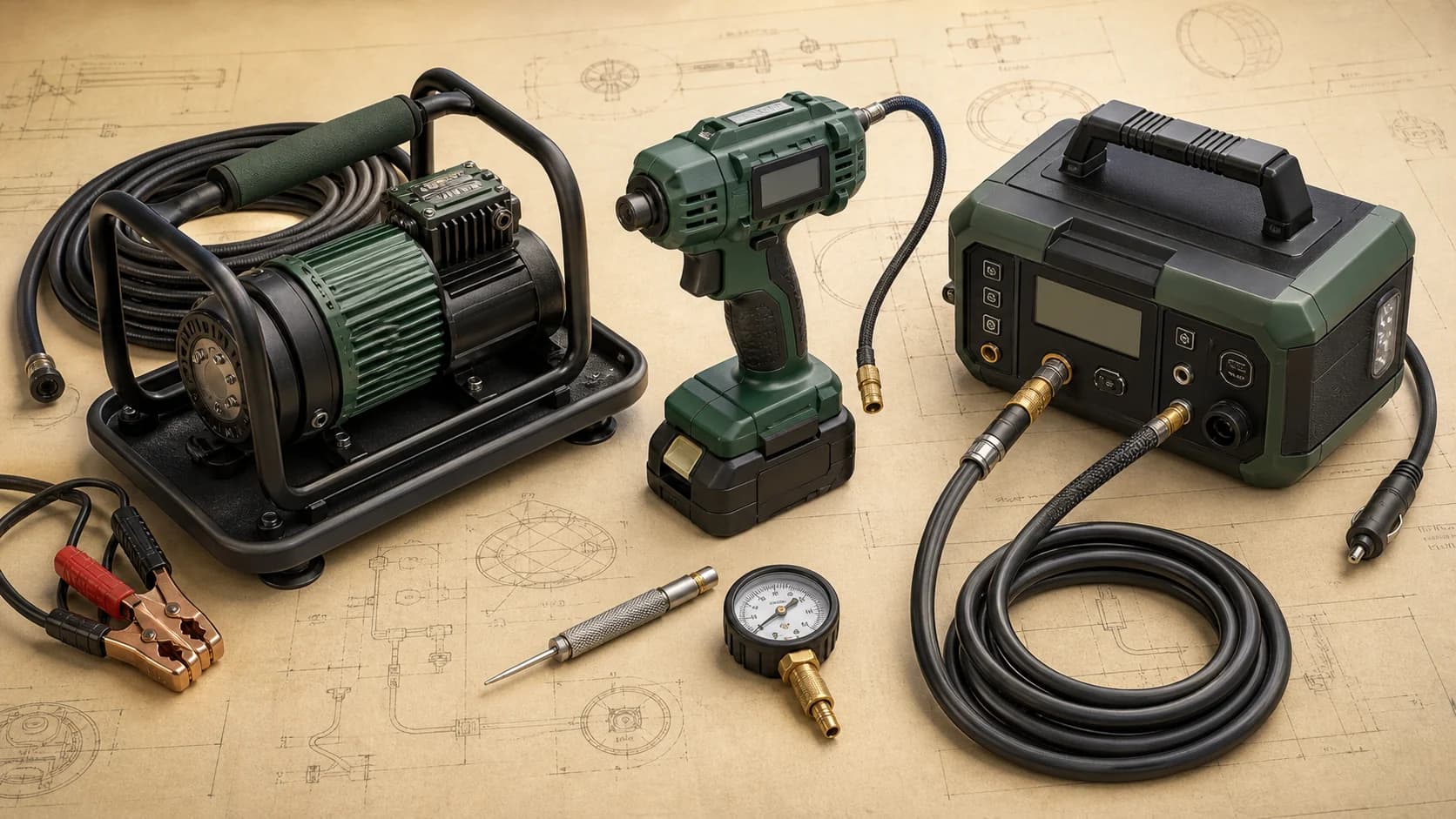
Maximum PSI alone does not prove useful performance. Match the inflator to the cold-pressure requirement, tire volume, number of tires, duty cycle, power source, hose reach, and valve access.
Original TowCheck editorial artwork. Generic equipment is shown; product-format diagrams below are not scale replicas.
01 · Start here
Three distinct fits, not a universal winner
Choose the operating pattern that resembles your setup, then verify every capacity and compatibility constraint.
01
rv compressor
Best for Large RV layouts needing long hose reach and dually chucks
VIAIR 400P-RV Automatic (40047)
The RV-specific choice when direct battery clamps, 60 feet of combined coil hose, and dual-wheel valve tools matter more than cordless convenience.
Max pressure
150 PSI max working
Power
12 V battery clamps; 30 A max
Important limit: The manual defines the duty cycle as 20 minutes on and 40 minutes off at 72°F and 100 PSI. The compressor becomes hot, must run from a 12-volt vehicle battery with the engine running, and the included hose is not recommended below freezing.
Best for Cordless top-offs when an M18 battery system is already available
Milwaukee M18 Inflator 2848-20
The cordless speed-and-convenience pick for passenger, light-truck, and other medium-duty tires, including pressures over 100 PSI within its 150-PSI maximum.
Max pressure
150 PSI max
Power
M18 battery
Important limit: It is optimized for medium-duty tires, not described as an RV multi-tire kit. Reach is only the 36-inch hose, battery and charger are separate, and the manual limits continuous operation.
Best for Mixed camping use with battery, 12 V, and optional AC power
DEWALT DCC020IB
The versatility pick when tire top-offs share space with mattresses and inflatables, and three possible power sources are more useful than RV-length hose reach.
Max pressure
Digital setpoint; max not stated on product page
Power
20V MAX, 12 V DC, optional 110 V AC
Important limit: The reviewed Canadian page does not publish an airflow or duty-cycle number, and the battery, charger, and AC adapter are sold separately. The 12V sheet specifies a 10-amp draw and compatible fused outlet.
Use the tire and vehicle/trailer manufacturer information for pressure. The calculator supports load planning; it does not create a new inflation specification.
We favour documented constraints and reproducible setup over feature count. These pages do not represent hands-on laboratory testing unless explicitly stated.
01
Required cold pressure, tire volume and construction, number of tires, starting pressure, useful flow at pressure, and manufacturer duty cycle.
02
Battery clamps, fused 12V outlet, cordless pack, or AC adapter; current draw, cable routing, engine-running instructions, and stored energy for the whole job.
03
Hose and power-cord reach, dually valve orientation, chuck type, valve-stem clearance, gauge behaviour, and auto-shutoff method.
04
Operating temperature, hot surfaces, ventilation, moisture/dust limits, cooldown, storage, accessories, service, and warranty.
04 · Product notes
Where each option fits—and where it does not
Each recommendation is conditional. The “avoid when” note matters as much as the feature list.
rv compressor
Max pressure
150 PSI max working
Power
12 V battery clamps; 30 A max
Runtime limit
33% at 100 PSI
Pick 1 · Large RV layouts needing long hose reach and dually chucks
VIAIR 400P-RV Automatic (40047)
The RV-specific choice when direct battery clamps, 60 feet of combined coil hose, and dual-wheel valve tools matter more than cordless convenience.
Why it fits
VIAIR publishes 150-PSI working pressure, 2.30 CFM at zero PSI, 33-percent duty cycle at 100 PSI, 30-amp draw, IP54 rating, 60-foot hose system, and extended chucks.
Strengths
RV-length hose system
Dually valve extensions
Published duty cycle and manual
Tradeoffs
Battery-clamp access required
20 min on / 40 min off at stated test point
Compatibility check
Confirm battery access, safe clamp routing, 40-amp fuse, hose reach to every valve, dually chuck orientation, and the tire’s required cold pressure.
Avoid when
You cannot safely reach the battery, need freezing-weather hose operation contrary to the note, or the inflation sequence would exceed the stated duty cycle.
Published limitation
The manual defines the duty cycle as 20 minutes on and 40 minutes off at 72°F and 100 PSI. The compressor becomes hot, must run from a 12-volt vehicle battery with the engine running, and the included hose is not recommended below freezing.
Warranty record
One year from original purchase in the reviewed user manual, subject to its conditions.
Pick 2 · Cordless top-offs when an M18 battery system is already available
Milwaukee M18 Inflator 2848-20
The cordless speed-and-convenience pick for passenger, light-truck, and other medium-duty tires, including pressures over 100 PSI within its 150-PSI maximum.
Why it fits
Milwaukee publishes a 150-PSI maximum, 36-inch hose, auto pressure check and shutoff, four presets, ±1 PSI comparison accuracy, 1.41 SCFM at zero PSI, and five-year tool warranty.
Strengths
Cordless portability
Automatic pressure check and shutoff
Four pressure memory slots
Tradeoffs
Battery sold separately in tool-only package
Shorter reach than RV compressor kits
Compatibility check
Requires a charged genuine M18 battery, direct access to each Schrader valve, and a planned battery reserve for every tow-vehicle and trailer tire.
Avoid when
A long coach or dually valve layout needs remote hose reach, no M18 battery ecosystem exists, or the documented tire volume and inflation task exceed the tool’s intended class.
Published limitation
It is optimized for medium-duty tires, not described as an RV multi-tire kit. Reach is only the 36-inch hose, battery and charger are separate, and the manual limits continuous operation.
Warranty record
Five-year tool warranty stated on the reviewed Canadian product page.
Pick 3 · Mixed camping use with battery, 12 V, and optional AC power
DEWALT DCC020IB
The versatility pick when tire top-offs share space with mattresses and inflatables, and three possible power sources are more useful than RV-length hose reach.
Why it fits
DEWALT documents high-pressure auto shutoff, separate high-volume inflation/deflation, 20V MAX battery or included 12V DC operation, optional 110V AC adapter, threaded chuck, LED, and 5.5-pound tool mass.
Strengths
Three possible power sources
High-pressure and high-volume modes
5.5-lb published tool mass
Tradeoffs
AC adapter and battery sold separately
No airflow figure on reviewed product page
Compatibility check
Confirm that the exact package includes the intended power accessories, the vehicle 12V outlet and fuse support the manual requirement, and the short high-pressure hose reaches every valve.
Avoid when
You need documented high-volume tire performance, long dually/RV reach, or expect the optional AC adapter or battery to be in a tool-only box.
Published limitation
The reviewed Canadian page does not publish an airflow or duty-cycle number, and the battery, charger, and AC adapter are sold separately. The 12V sheet specifies a 10-amp draw and compatible fused outlet.
Warranty record
Three-year limited warranty, one-year free service, and 90-day satisfaction guarantee stated on the reviewed Canadian page; read full terms.
Choose from the entire inflation job, not the maximum-PSI label.
05 · Selection method
How to make the final choice
A product page tells you what a component can do. Your measured setup determines whether it belongs in the system.
01
Use the correct pressure source
Set cold pressure from the vehicle, trailer, and tire manufacturer information for the actual load. Do not inflate to the tire sidewall maximum merely because the compressor can reach it.
02
Time the whole route
Check hose and cable reach to the farthest and inner-dual valves, then include every tow-vehicle and trailer tire in the duty-cycle and battery plan.
03
Carry a separate gauge
Verify pressure with a suitable gauge, especially after disconnecting a long hose or when an inflator’s displayed pressure needs time to stabilize.
Safety boundary
Before you install or operate
Inflate cold tires to the applicable vehicle/trailer specification and never exceed tire, wheel, valve, hose, or compressor limits.
Keep the compressor ventilated and stable, observe hot-surface and cooldown warnings, and disconnect power before handling or service.
Route cables and hoses away from traffic, exhaust, fans, belts, pinch points, sharp edges, and water; follow engine-running and battery-connection order exactly.
An inflator addresses pressure, not tire damage. Do not continue on a tire with visible structural damage, severe air loss, unknown cause, or an unsafe roadside working position.
06 · Common questions
Questions to settle before checkout
Is 150 PSI enough for trailer or RV tires?
It may be, but maximum pressure does not prove adequate airflow, duty cycle, reach, or compatibility. Compare the full task with the manual.
Should I inflate to the number on the tire sidewall?
Use the vehicle/trailer and tire manufacturer information for the loaded application. The sidewall maximum is not automatically the correct operating pressure.
Can a TPMS replace pressure checks?
No. A TPMS provides alerts and trend information. Begin with verified cold pressures and inspect tires, wheels, valves, and sensors.
Source record
Documents reviewed for this comparison
We prefer current manufacturer pages and manuals. A retailer is used where it is the clearest available record and is labeled as such.
VIAIR 400P-RV Automatic (40047)
Last checked July 22, 2026
VIAIR 400P-RV product specifications manufacturer · checked 2026-07-22Pressure, flow, duty cycle, current, IP rating, mass, hoses, chucks, temperature note, and included equipment.
VIAIR 400P-RV user manual manual · checked 2026-07-22Duty-cycle definition, fuse, pressure switch, hot-surface and water warnings, battery-clamp operation, cooling, inflation procedure, and warranty.